Will Every Indian Small Business Have Its Own Online Store by 2030?
India's small-business landscape is undergoing a digital transformation. From neighbourhood clothing shops and home-based food businesses to local manufacturers and independent creators, entrepreneurs are finding new ways to reach customers beyond their immediate communities. As digital payments, smartphones and e-commerce infrastructure become more accessible, one important question emerges: will every Indian small business have its own online store by 2030?
The answer may not be every business, but owning an online storefront could become a much more common part of running a business.
Why Online Stores Are Becoming More Important
For years, many small businesses depended on walk-in customers, word-of-mouth recommendations and local distributors. While these channels remain valuable, they can limit a business's reach. An online store gives entrepreneurs another way to showcase products, communicate with customers and accept orders beyond their local market.
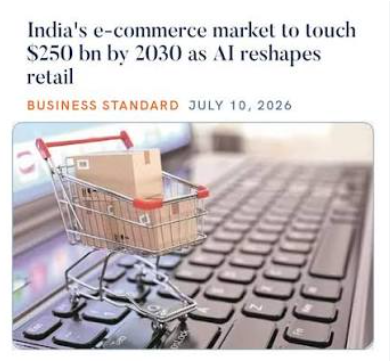
According to McKinsey's February 2026 report, India's e-commerce market could grow from approximately $70–80 billion in 2024 to $180–200 billion by 2030. The report identifies micro, small and medium enterprises (MSMEs) and direct-to-consumer selling as important drivers of this growth. This signals a significant opportunity for small businesses willing to adopt digital channels.
Government Initiatives Are Supporting Digital Adoption
India's digital commerce ecosystem is also expanding through initiatives such as the Open Network for Digital Commerce (ONDC). Rather than operating as a single marketplace, ONDC enables participating buyer and seller applications to connect through an open network.
The government's MSME Trade Enablement and Marketing (TEAM) initiative is designed to help eligible micro and small enterprises improve their digital presence through onboarding, catalogue creation, branding and market access. Such initiatives can reduce some of the barriers that traditionally prevented smaller sellers from exploring e-commerce.
However, technology alone cannot guarantee success. Business owners still need accurate product information, competitive pricing, reliable fulfilment and customer service.
What Could Prevent Every Business from Going Online?
Despite the opportunities, universal adoption by 2030 is not guaranteed. Some entrepreneurs may lack the digital skills, time or resources needed to manage an online business. Others operate in sectors where face-to-face interactions remain essential.
There are also practical challenges, including customer acquisition costs, competition, returns, delivery coordination and building trust with first-time buyers. Simply launching a website does not automatically generate traffic or sales.
The more realistic future is a combination of physical shops, social commerce, online marketplaces and independent storefronts. Businesses will choose the channels that suit their customers, products and operating models.
How factori.com Fits into This Future
This is where factori.com becomes relevant. For aspiring entrepreneurs who want to enter e-commerce without investing heavily in physical inventory, the platform offers an accessible route to establishing an online selling presence.
Its stated offering includes zero inventory, zero commission and zero shipping cost, access to more than 10,000 products, a dedicated domain, Razorpay payment gateway, Shiprocket integration, Google Analytics, advertising tools and ChatGPT integration. These features can help simplify the process of setting up and managing an online business, subject to the platform's current terms and conditions.
For example, a first-time entrepreneur could use Instagram and WhatsApp to promote products, direct interested customers to a factori.com storefront and use available analytics to understand customer behaviour. Instead of building every part of the e-commerce infrastructure independently, the seller can focus more on content, customer relationships and marketing.
This model may be especially useful for people who want to explore online entrepreneurship before committing to traditional inventory and warehousing expenses. Sellers should verify the platform's current pricing, fulfilment arrangements and other terms before getting started.
Reference links
-
McKinsey — The Great Unbundling of Indian E-Commerce: MSMEs and the Direct-to-Consumer Revolution — Market outlook and the role of MSMEs through 2030.
-
Press Information Bureau — ONDC and Small Businesses — Government overview of digital commerce and market access.