
Starting a business has traditionally required significant upfront investment — from renting a physical shop and purchasing inventory to hiring employees and managing day-to-day operations. E-commerce is changing that model by allowing entrepreneurs to reach customers online without necessarily building a traditional storefront or maintaining large inventories.
India's e-commerce market is expanding rapidly. According to BCG, India's e-commerce market could reach $280–300 billion by 2030, with smaller cities, rural consumers, quick commerce, social commerce and other digital channels contributing to this growth.
The Shift From Traditional Retail to Digital Business
Traditional businesses often require entrepreneurs to invest before they know whether customers will actually buy their products. E-commerce offers a different approach: entrepreneurs can establish an online presence, test products, understand customer behaviour and adjust their businesses based on demand.
The biggest change is accessibility. Tools and platforms now bring together several elements that an online business needs, including storefronts, product listings, payments, order management and fulfilment. This allows entrepreneurs to focus more on understanding customers and building demand instead of managing every piece of technology themselves.
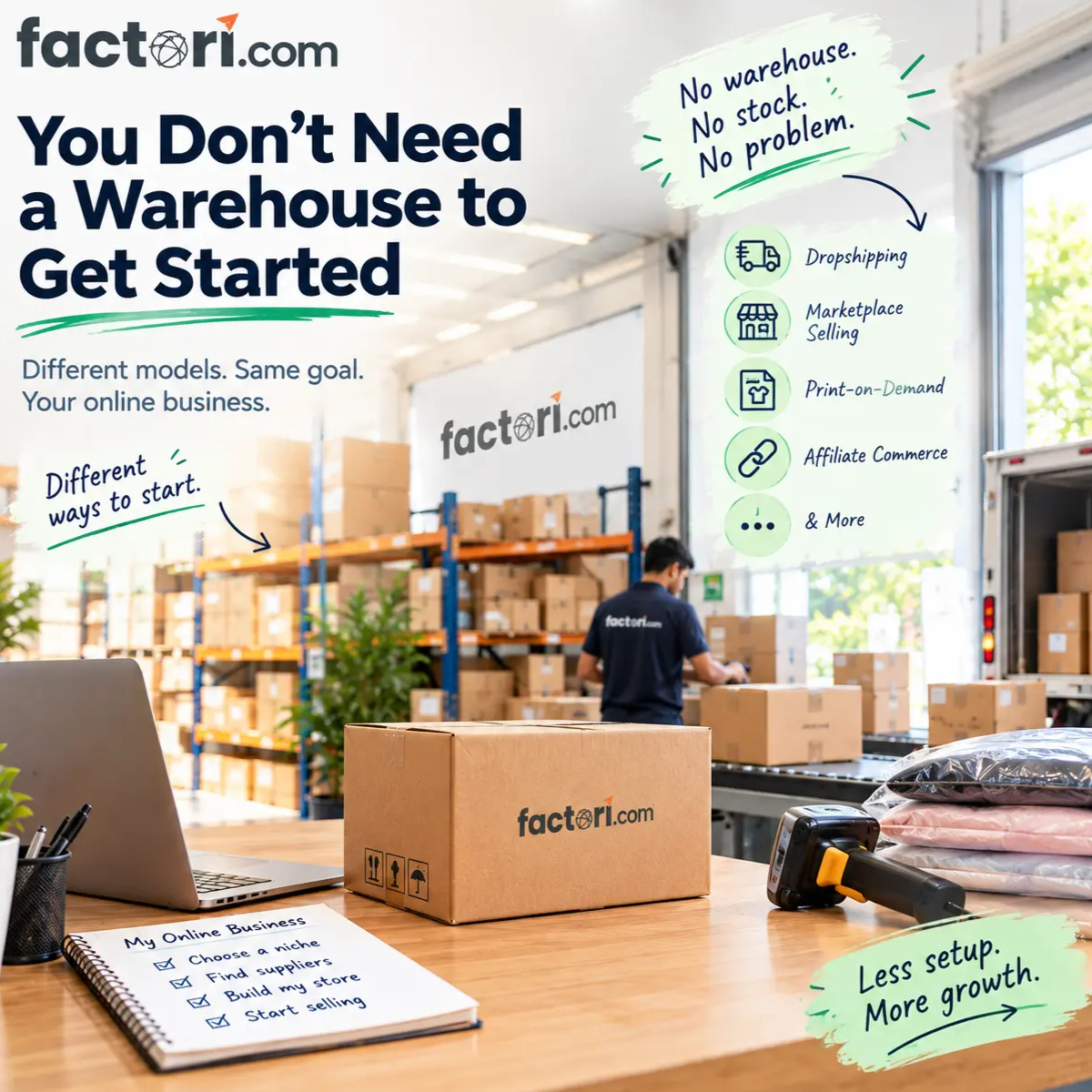
You Don't Need a Warehouse to Get Started
Starting an online business does not always mean purchasing and storing large quantities of inventory. Models such as dropshipping, marketplace selling, print-on-demand and affiliate commerce can offer different approaches to inventory and fulfilment.
However, lower upfront inventory requirements do not mean zero risk. Entrepreneurs still need to consider product quality, supplier reliability, pricing, margins, delivery, returns and customer service.
The important distinction is simple:
Starting a business doesn't necessarily mean building a warehouse first.
Technology Is Lowering Some Barriers
A modern online business typically requires a storefront, product catalogue, payment system, customer communication, order management, fulfilment and marketing.
Previously, entrepreneurs might have needed multiple vendors or technical expertise to put these systems together. Today, digital platforms can combine several of these functions, making online commerce more accessible to smaller businesses.
This allows entrepreneurs to spend more time on what ultimately drives a business: finding customers, creating demand and delivering a good customer experience.
Where factori.com Fits
This is the thinking behind factori.com.
The platform is designed to simplify the process of launching an online store, giving entrepreneurs access to their own storefront and a catalogue of products without requiring them to build the entire e-commerce infrastructure from scratch.
The idea is not to remove the work involved in entrepreneurship. Marketing, customer acquisition and business decisions still depend on the entrepreneur.
Instead, the goal is to reduce some of the infrastructure required before someone can begin testing an online business idea.
Start Small, Learn and Then Scale
For a first-time entrepreneur, the goal doesn't have to be spending as much as possible at the beginning.
A more practical approach is to:
- Choose a category.
- Understand the target customer.
- Research competitors.
- Build an online presence.
- Test products and demand.
- Track customer behaviour.
- Invest further when there is evidence of demand.
The question is gradually shifting from "How much money do I need to start?" to "How quickly can I test whether my idea works?"
The Future of Small Business Is Digital
India's e-commerce growth is not limited to large marketplaces. Smaller businesses and MSMEs are becoming an increasingly important part of the digital commerce ecosystem. McKinsey's research highlights the growing role of MSMEs and direct-to-consumer businesses in India's e-commerce expansion.
For entrepreneurs, this creates new possibilities. An online business does not necessarily have to begin with a physical shop, warehouse or large team. It can begin with an idea, an understanding of the customer and the digital infrastructure needed to connect the two.
E-commerce has not eliminated the challenges of entrepreneurship — but it has changed what an entrepreneur needs to build before getting started.