
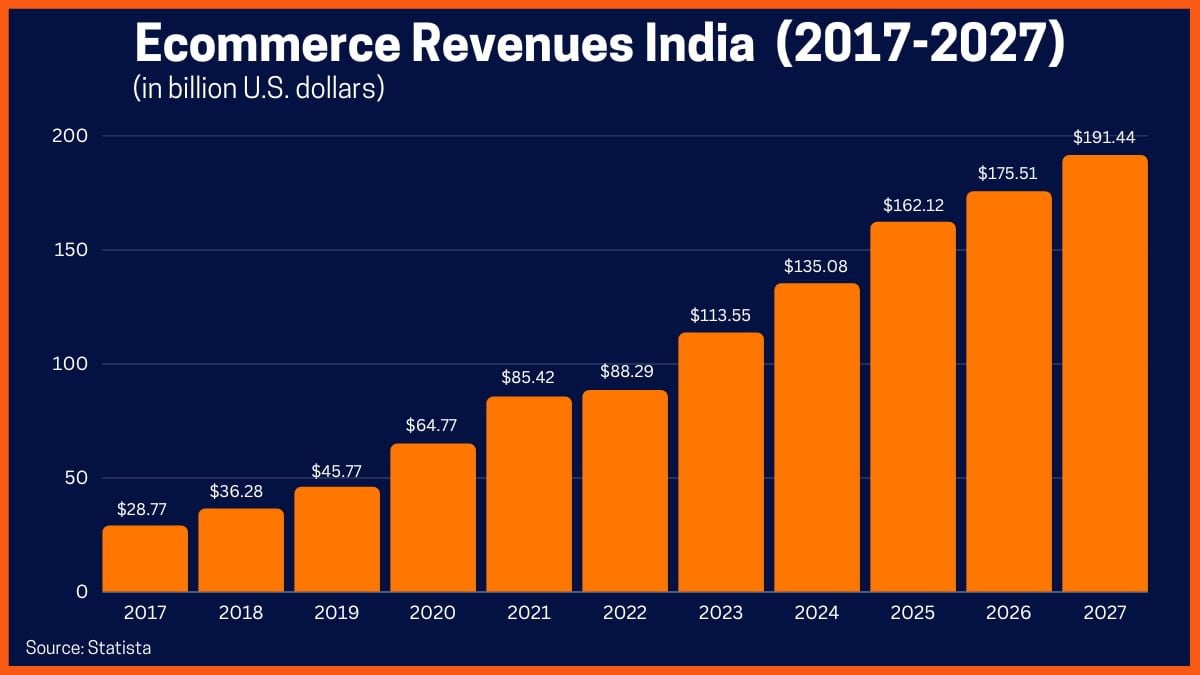
India's e-commerce industry is expanding at an extraordinary pace. From established marketplaces to quick-commerce platforms and digital-first brands, companies are investing heavily in technology, logistics, warehouses, customer acquisition and market expansion. However, this rapid growth raises an important question: are Indian e-commerce companies expanding faster than their business models can support?
According to the India E-Commerce Report 2026 by the Centre for Social and Economic Progress (CSEP), India's merchandise e-commerce market expanded from approximately $14 billion in 2014 to $120–130 billion in 2024. The market is projected to reach $300–350 billion by 2030, growing at an annual rate of 20–25%. Despite this growth, profitability remains a major challenge for several companies. The report highlights that Indian e-commerce platforms generate gross margins of approximately 40–43%, yet struggle to translate these into consistent net profits.
1. The Race to Capture Market Share
Competition has become one of the biggest drivers of expansion. Companies are entering new categories, targeting smaller cities, introducing faster delivery services and spending heavily on customer acquisition. The objective is to establish a stronger market presence before competitors capture the same customer base.
According to Redseer's September 2026 industry report, India's online retail market crossed approximately $38 billion in the first half of 2026, recording around 25% year-on-year growth. The full-year market is projected to exceed $90 billion. While these numbers demonstrate enormous potential, they also encourage companies to invest aggressively to capture emerging opportunities.
2. Quick Commerce and the Cost of Expansion
Quick commerce provides a clear example of how competition can accelerate expansion. Companies are establishing dark stores, expanding delivery networks and promising increasingly faster deliveries. While these services improve convenience, they also require substantial investment in infrastructure, inventory management and delivery operations.
A January 2026 report by Mint highlighted the growing pressure on quick-commerce companies to balance customer acquisition with sustainable unit economics. Expansion into additional cities and warehouses can increase operating costs before sufficient order volumes are achieved.
3. Growth Does Not Always Mean Profitability
A growing customer base and increasing order volumes do not automatically translate into profits. Discounts, customer acquisition expenses, product returns, cash-on-delivery transactions and last-mile delivery costs can significantly affect margins.
The CSEP report also highlights structural challenges such as relatively low average revenue per customer and high logistics expenses. Companies must therefore look beyond headline growth and focus on customer retention, operational efficiency and sustainable revenue generation.
CSEP+1
4. A More Sustainable Opportunity for Independent Retailers
The expansion of large marketplaces is only one part of India's digital commerce story. Independent retailers, small businesses and aspiring entrepreneurs also have an opportunity to participate in this growing industry without competing directly with large platforms on infrastructure or delivery speed.
This is where retailing.factori.com becomes relevant. The platform helps individuals and retailers establish their own online stores in approximately 30 minutes, without coding, inventory investment or the need to manage warehouses. With access to over 10,000 products, integrated Razorpay payments, and packaging and shipping support, retailers can concentrate on marketing their stores and developing their customer base while the platform handles essential operational activities.
Instead of investing heavily in building an independent e-commerce infrastructure, entrepreneurs can start with a more accessible business model, establish their own domain and brand identity, and gradually develop their online presence.
Ultimately, the future of Indian e-commerce will not be determined by how quickly companies expand, but by how effectively they convert growth into sustainable businesses. Expansion creates opportunities, but long-term success depends on profitability, customer trust and operational discipline.