
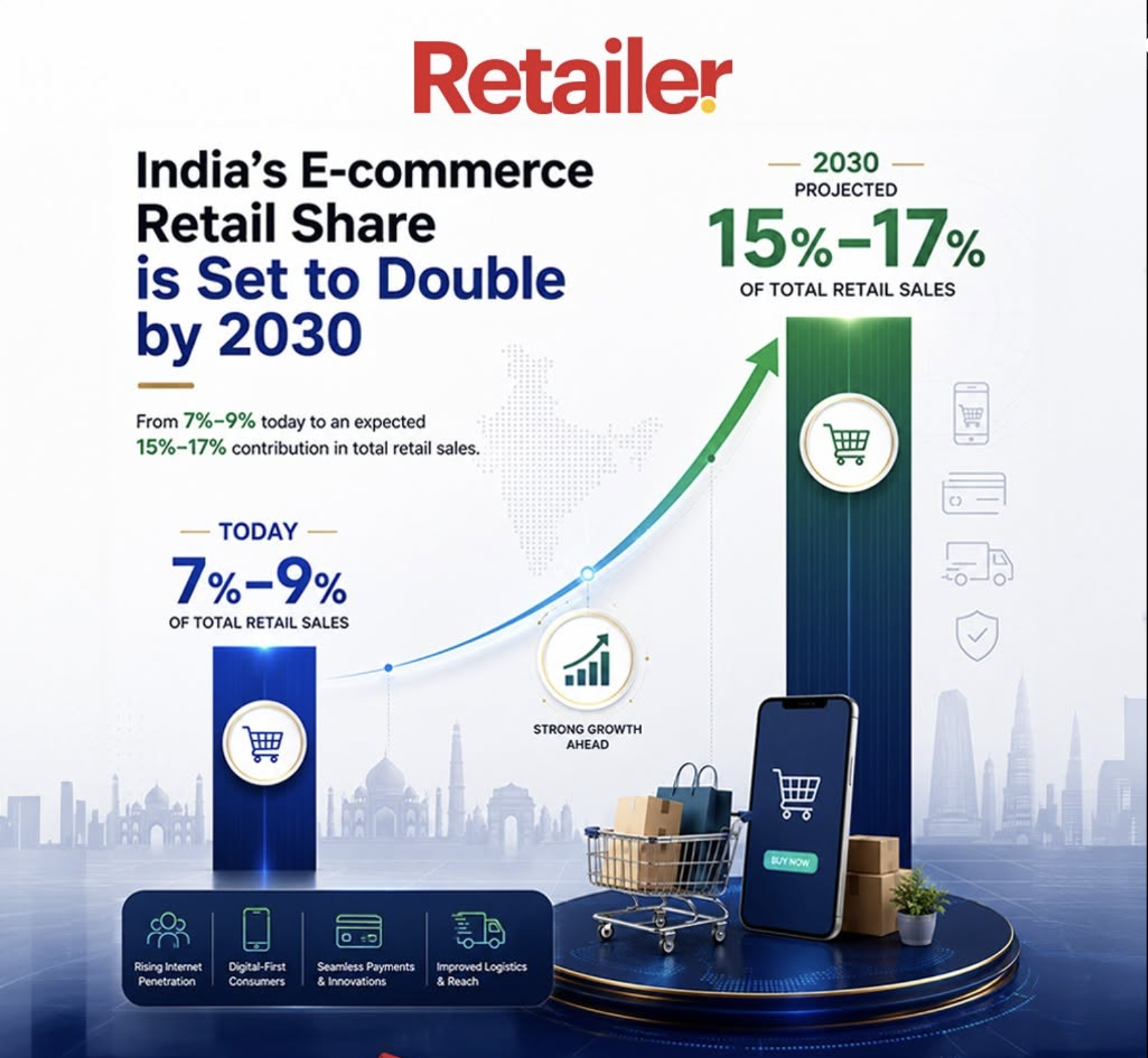
India’s e-commerce story is entering a new phase. What began as a convenient way to shop online is becoming a broad commercial ecosystem connecting consumers, neighbourhood retailers, emerging brands, creators, logistics providers and digital entrepreneurs. By 2030, this transformation could create one of the biggest opportunities for India’s next generation of business owners.
A February 2026 report by Boston Consulting Group (BCG) estimates that India’s e-commerce market could reach $280–300 billion by 2030, up from an estimated $120–140 billion today. The report draws on research involving more than 12,000 shoppers across urban and rural India. A separate Google-Deloitte report puts the e-commerce opportunity at $250 billion by 2030, highlighting how different definitions and market segments can produce different estimates. Both point to the same direction: digital commerce is set for substantial expansion.
The Next Wave Will Come from Beyond the Metros
The opportunity is no longer limited to consumers in large cities. Smaller towns and rural markets are becoming an increasingly important part of online demand. BCG estimates that India's online shopper base could grow from nearly 300 million today to around 440 million by 2030. Rural consumers already account for approximately 30% of online shoppers, while women represent about 45% of the digital shopper base.
For entrepreneurs, this means demand can be built around local preferences, regional products and communities that have often been underserved by traditional retail. A home-based seller, a family-run shop or a regional manufacturer can now reach customers well beyond its immediate neighbourhood. New Business Models Are Lowering the Entry Barriers
The next generation of entrepreneurs will not be limited to building large warehouses or investing heavily in inventory. Direct-to-consumer brands, social and chat commerce, creator-led discovery, niche online stores and connected online-offline retail are opening different routes to market. Customers may discover a product through a video or social post, ask questions over chat, compare options online and complete the purchase through a digital storefront.
According to the Ministry of MSME, approximately 206,000 merchants had completed at least one transaction on the ONDC network by December 31, 2025. This signals growing participation in digital commerce, although building a sustainable business still requires product quality, customer service, pricing discipline and consistent promotion.
An Opportunity for First-Time and Small Entrepreneurs
For aspiring business owners, the biggest shift is the ability to start smaller, test demand and grow gradually. A retailer does not necessarily need to abandon an existing shop to build an online presence. A home entrepreneur can begin with a focused category. A young founder can use customer feedback and sales data to refine products before expanding.
Platforms such as factori.com are designed to simplify this starting point by helping sellers create an online store under their own name, access a catalogue of 10,000+ products, accept digital payments and use integrated packing and shipping support, without needing coding skills or maintaining inventory for every product.
What Will Separate Opportunity from Success?
A growing market does not guarantee success for every seller. Entrepreneurs will need to understand their customers, select dependable products, communicate transparently, protect customer data and deliver a consistent buying experience. They must also account for returns, margins, fulfilment timelines and the cost of acquiring customers. Digital tools can reduce complexity, but business fundamentals remain essential.
By 2030, India's e-commerce growth could create room for millions of smaller, more specialised businesses alongside established brands and marketplaces. The opportunity for the next generation is not simply to sell online; it is to build trusted businesses with their own identity, customer relationships and long-term value. With the right combination of local insight, digital skills and accessible infrastructure, entrepreneurship can become more practical for people who may once have considered starting a business out of reach.
References:
1. Boston Consulting Group (BCG) – $300 Billion Connected Commerce: How Clicks and Bricks Are Defining India's E-commerce Future (February 2026).
2. Google and Deloitte – India's E-commerce Market Set to Reach $250 Billion by 2030 (April 2026).
3. Press Information Bureau, Ministry of MSME – Government Periodically Assesses Digital Adoption Among MSMEs (March 2026).
4. India Brand Equity Foundation (IBEF) – India's E-retail Market Set to Reach $190 Billion by 2030 (March 2025).